

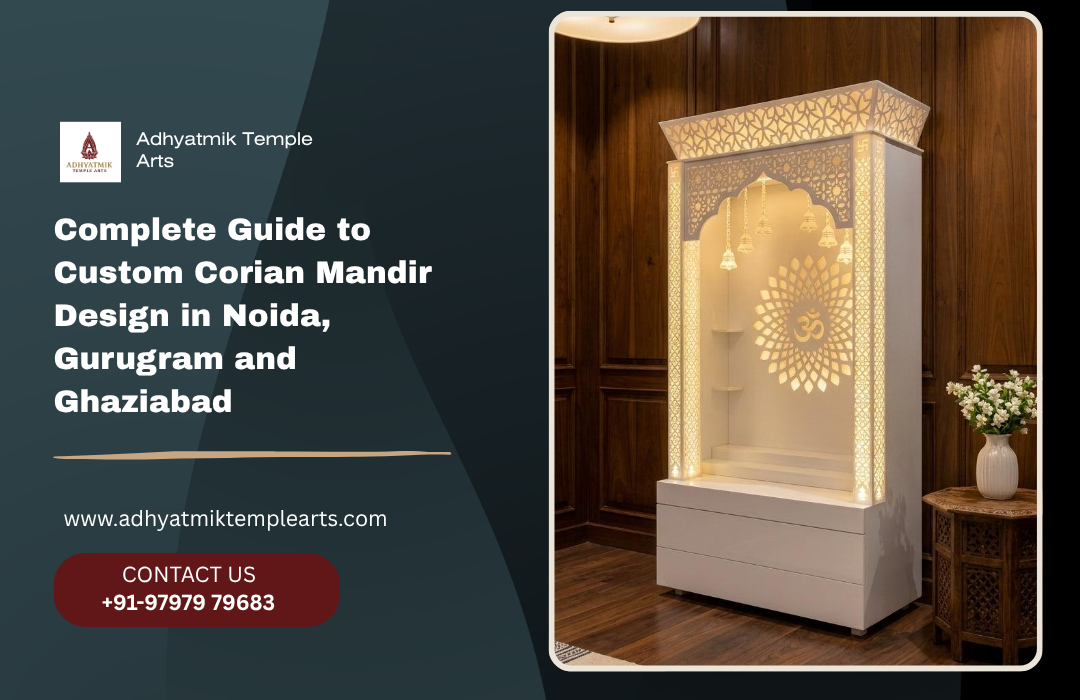
Complete Guide to Custom Corian Mandir Design in Noida, Gurugram and Ghaziabad
A home mandir is not simply another piece of furniture. For many Indian families, it is the most peaceful and meaningful corner of the home—a place for daily prayers, meditation, festivals and moments of personal reflection.
As homes in Noida, Gurugram and Ghaziabad become more contemporary, homeowners are looking for temple designs that respect traditional values while fitting naturally into modern interiors. This is where a custom Corian mandir offers an interesting solution.
Instead of choosing a standard-sized temple from a catalogue, a custom Corian mandir can be planned around the actual wall, room, ceiling height, interior theme, preferred deity, storage requirements and lighting.
The result is a temple that feels as though it was designed specifically for the home.
What Is a Custom Corian Mandir?
A custom Corian mandir is a home temple created according to the customer’s specific space and design requirements.
Unlike a ready-made wooden or marble temple, the dimensions, decorative panels, motifs, lighting and storage can all be planned together.
A Corian or solid-surface temple can be designed with elements such as:
- CNC-cut patterns
- Om and Swastik motifs
- Shree and traditional symbols
- Lotus and floral designs
- Peacock-inspired patterns
- Backlit panels
- Decorative jali work
- Layered panels
- Integrated shelves
- Storage drawers
- Decorative pillars
- Wall-mounted structures
- Floor-standing temples
- Full pooja-room installations
This makes Corian particularly interesting for homeowners who want something more personal than a standard temple.
Why Are Custom Corian Mandirs Becoming Popular in NCR?
One family may live in a compact high-rise apartment, while another may have a large independent house or luxury villa. Consequently, a single standard mandir size cannot work equally well in every home.
A custom design solves this problem.
For a small apartment, the temple can occupy a relatively narrow wall without consuming valuable floor space.
For a larger house, the same design concept can be expanded into a complete pooja wall with storage, decorative side panels and lighting.
The growing popularity of contemporary interior design has also changed what homeowners expect from a mandir. People increasingly want the temple to complement the home’s architecture rather than look like an unrelated object placed inside the room.
Corian Mandir vs Traditional Temple Designs
There is no universally “best” material for a mandir. The right choice depends on the homeowner’s taste, room and maintenance expectations.
However, Corian offers several design possibilities that make it suitable for contemporary spaces.
| Feature | Custom Corian Mandir | Wooden Mandir | Marble Mandir |
|---|
| Modern appearance | Excellent | Good | Excellent |
| Traditional appearance | Excellent with suitable motifs | Excellent | Excellent |
| CNC detailing | Excellent | Excellent | Good |
| Backlighting | Excellent | Good | Possible |
| Custom sizing | Excellent | Excellent | Moderate |
| Seamless appearance | Excellent | Depends on construction | Limited by joints |
| Maintenance | Relatively easy | Moderate | Moderate |
| Apartment suitability | Excellent | Good | Depends on weight/design |
| Design flexibility | Very high | High | Moderate to high |
The important point is not to select a material only because it is currently fashionable. The design should work with the home’s existing interiors and the family’s daily use.
Latest Custom Corian Mandir Design Ideas for 2026
Modern mandir design is becoming more refined. Instead of simply adding more decoration, designers are using layers, proportion, lighting and carefully selected motifs to create visual depth.
Here are some design concepts worth considering.
1. Backlit Corian Mandir
Backlighting can transform a relatively simple temple into a striking focal point.
A soft LED source behind a CNC-cut panel can illuminate an Om, Shree, lotus, Swastik or other selected motif.
Warm lighting generally creates a softer and more devotional atmosphere than extremely bright lighting.
The key is balance.
The light should enhance the temple—not overpower it.
2. Layered Corian Mandir
Layering is an effective way to give a flat wall greater depth.
For example, a design may use:
Base panel → decorative CNC layer → illuminated centre layer
The central design becomes the focal point while the outer layers provide architectural depth.
This style works particularly well behind idols because the background can remain visually interesting without distracting from the main deity.
3. Mor Pankh-Inspired Mandir
Peacock-feather-inspired patterns can be incorporated into a contemporary temple without making the overall design look old-fashioned.
The pattern can be used as:
- A centre panel
- Side decoration
- Jali pattern
- Backlit feature
- Border element
It can work especially well for Krishna-inspired interiors.
4. CNC Jali Corian Mandir
CNC-cut jali panels can introduce traditional architectural detailing while maintaining a modern appearance.
Possible patterns include:
- Lotus
- Bells
- Floral motifs
- Geometric patterns
- Traditional Indian arches
- Peacock designs
The jali can also be combined with concealed lighting to create shadows and depth.
6. Full-Height Corian Pooja Wall
For larger houses, instead of creating only a small temple unit, the entire wall can become the sacred feature.
A full-height design can incorporate:
- Central deity area
- Decorative side panels
- Shelves
- Storage
- Lighting
- CNC detailing
- Traditional architectural elements
This approach is especially suitable for independent homes and villas.
How to Select the Right Mandir Size
One of the biggest mistakes homeowners make is selecting a design before considering the actual space.
The first step should be measuring the location.
Record:
- Wall width
- Available height
- Available depth
- Ceiling height
- Nearby furniture
- Electrical points
- Door and window positions
- Required storage
- Idol dimensions
Then the design can be developed around these measurements.
Typical Design Approach
| Available Space | Suggested Concept |
|---|---|
| Small wall | Compact wall-mounted mandir |
| Medium wall | Layered Corian temple |
| Wide living-room wall | Designer feature-wall mandir |
| Dedicated pooja area | Full-height temple |
| Large villa | Custom pooja room |
| Narrow niche | Slim floating temple |
The exact dimensions should always be determined after measuring the actual site.
Designing a Corian Mandir for Noida Homes
Noida has a large number of modern apartments where floor space can be limited.
For these homes, a wall-mounted Corian mandir can be a practical solution.
A compact design may include:
- One back panel
- Central Om or Shree
- Two decorative side sections
- A small pooja shelf
- Concealed LED
- One or two storage drawers
This allows homeowners to create a dedicated spiritual area without sacrificing too much living space.
For larger Noida homes, the mandir can become a complete feature wall.
Adhyatmik Temple Arts operates from Sector 9, Noida and provides customised Corian mandir solutions.
Corian Mandir Design for Gurugram Homes
Gurugram interiors often combine contemporary architecture with premium materials such as wood, marble, glass and metal.
A Corian mandir can be designed to complement these elements.
For example:
White Corian + warm LED + wood finish + brass accents
can produce a sophisticated combination.
For a luxury apartment, a relatively minimal temple may work better than an oversized traditional structure.
For a villa or independent home, however, a larger architectural temple can be designed as the centrepiece of a dedicated pooja area.
The objective should always be to make the mandir feel integrated into the interior.
Corian Mandir Design for Ghaziabad Homes
Ghaziabad includes everything from compact apartments to independent houses and larger residential properties.
For apartments, homeowners can consider:
- Wall-mounted temples
- Floating designs
- Compact CNC panels
- Minimal backlit temples
For independent houses, there is greater freedom to create:
- Floor-standing temples
- Full pooja walls
- Storage-integrated mandirs
- Pillared structures
- Larger decorative panels
A local custom approach is especially useful when the available space does not match standard ready-made temple dimensions.
Important Features to Discuss Before Ordering
Before approving a mandir design, do not discuss only its appearance.
Ask about the complete project.
| Requirement | Questions to Ask |
|---|
| Material | What material and thickness will be used? |
| Design | Is the design fully customised? |
| CNC | How detailed will the carving be? |
| Lighting | Is LED included? |
| Storage | Can drawers/cabinets be added? |
| Installation | Is professional installation available? |
| Delivery | How will the mandir be transported? |
| Finishing | How are edges and joints finished? |
| Maintenance | What cleaning method is recommended? |
| Warranty | What after-sales support is provided? |
This simple checklist can prevent misunderstandings later.
How a Custom Corian Mandir Is Created
A professionally planned project generally follows a sequence rather than immediately going into fabrication.
Step 1: Space Assessment
The available area is measured and photographed.
Step 2: Requirement Discussion
The homeowner explains the preferred deity, design style, colour, lighting and storage requirements.
Step 3: Design Development
A customised concept is prepared around the available dimensions.
Step 4: Design Approval
The final layout, motifs and major details are confirmed.
Step 5: Fabrication
The selected material is cut, shaped and finished according to the approved design.
Step 6: Lighting and Assembly
LED lighting and other integrated elements are fitted.
Step 7: Quality Check
The components are checked before dispatch.
Step 8: Installation
The completed mandir is installed at the required location.
A well-organised process is particularly important for custom temples because the final result depends on accurate measurements and careful fabrication.
Vastu and Modern Corian Mandir Design
Many homeowners want their contemporary mandir to respect traditional Vastu preferences.
Commonly considered factors include:
- Direction of the pooja area
- Position of idols
- Height of the platform
- Cleanliness around the temple
- Adequate ventilation
- Lighting
- Distance from bathrooms
- Placement of storage
However, every home has a different layout.
Rather than forcing a particular design into an unsuitable location, it is better to discuss the available architecture first and then develop a practical solution.
Traditional considerations and modern functionality can coexist when the design is planned thoughtfully.
How to Maintain a Corian Mandir
A beautiful temple should also remain easy to maintain.
Daily or regular maintenance can include:
- Removing dust with a soft cloth
- Cleaning diya or oil residue promptly
- Wiping moisture after cleaning
- Keeping electrical areas dry
- Avoiding unnecessarily harsh cleaning chemicals
- Following the material manufacturer’s care instructions
The exact maintenance method should depend on the specific solid-surface material used in the project.
What Determines the Price of a Custom Corian Mandir?
There is no single fixed price for a customised temple.
The final quotation can depend on:
- Overall dimensions
- Material specification
- Number of panels
- CNC complexity
- Number of layers
- LED lighting
- Storage
- Decorative elements
- Installation
- Transportation
- Special finishing
- Custom motifs
Therefore, two mandirs with the same width can have completely different prices if their designs have different levels of detailing.
| Design Level | Typical Characteristics |
|---|
| Basic | Simple panel + platform |
| Standard | CNC design + shelves |
| Premium | Layered panels + lighting |
| Luxury | Extensive CNC + storage + premium detailing |
| Complete Pooja Room | Temple + wall + storage + lighting + interior work |
A proper quotation should be prepared after understanding the actual design rather than giving a misleading one-size-fits-all price.
Why Customisation Matters More Than Following a Trend
A design may look spectacular in a photograph but may not work in your home.
For example, a large luxury temple could make a compact apartment appear crowded.
Similarly, a very minimalist temple may look under-designed in a large villa.
The right design should consider:
Space + Interior + Worship Requirements + Lighting + Storage + Personal Taste
This is why customisation is important.
The purpose of a custom mandir is not simply to make something different. It is to create something that feels naturally connected to the home.
Why Choose Adhyatmik Temple Arts for a Custom Corian Mandir?
Adhyatmik Temple Arts is based in Sector 9, Noida and specialises in customised Corian mandirs, designer temples and wall panels.
The company’s own website showcases designs including backlit temples, layered designs, CNC detailing, Mor Pankh-inspired designs and customised religious themes.
For customers in Noida and the wider Delhi NCR region, a local manufacturer can make communication, measurement, design discussion and installation coordination more convenient.
Adhyatmik Temple Arts also lists customised temple solutions for customers beyond the NCR region.
Frequently Asked Questions
1. Is Corian suitable for a home mandir?
Yes. Corian and other solid-surface materials can be used to create modern, customised temple designs with smooth finishes, detailed patterns and integrated lighting.
2. Can I create a completely customised Corian mandir?
Yes. The dimensions, motifs, panels, lighting, storage and overall structure can be designed around your requirements.
3. Can a Corian mandir be installed in a small apartment?
Yes. Wall-mounted and compact designs can be developed for apartments where floor space is limited.
4. Can LED lighting be added?
Yes. Backlighting can be incorporated into suitable panels and motifs.
5. Can I add Om, Shree, Swastik or deity designs?
Yes. Decorative and religious motifs can be incorporated into the design according to the customer’s requirements.
6. Can storage be added below the mandir?
Yes. Drawers, cabinets and concealed compartments can be incorporated depending on the available space.
7. Is a custom mandir more expensive than a ready-made mandir?
Not necessarily in every case. The cost depends on material, dimensions, detailing, lighting, storage and installation. A basic custom design can be very different from a highly detailed luxury temple.
8. Can I get a Corian mandir in Gurugram or Ghaziabad?
Yes. Custom mandir manufacturers serving Delhi NCR can provide designs and installation depending on the project location.
9. How do I choose the correct size?
Start by measuring the wall or dedicated pooja area. Then consider idol dimensions, required platform space, storage, lighting and surrounding furniture.
10. Can Corian mandirs be designed according to Vastu preferences?
The design can be planned around the homeowner’s preferred Vastu considerations, subject to the architecture and available space.
11. Which Corian mandir design is best for a modern home?
There is no single best design. Minimal white temples, layered CNC designs, backlit panels and contemporary traditional motifs are all suitable options depending on the interior.
12. How do I get an accurate quotation?
Share the location, approximate dimensions, photographs of the available space and your preferred design. A manufacturer can then assess the requirements and prepare a more meaningful quotation.
Final Thoughts
A custom Corian mandir should not simply be designed to look impressive in a photograph.
It should feel right when you sit in front of it every day.
For homes in Noida, Gurugram and Ghaziabad, the best temple designs are those that combine traditional symbolism with the practical realities of modern homes.
A carefully planned Corian mandir with CNC detailing, soft backlighting, appropriate proportions and useful storage can transform an unused wall or corner into a meaningful spiritual space.
Whether you are planning a compact apartment mandir, an elegant living-room feature wall or a complete luxury pooja room, customisation gives you the freedom to create a design around your home rather than changing your home around a standard temple.
Adhyatmik Temple Arts provides customised Corian mandir and designer temple solutions from Noida for homeowners looking for a balance of devotion, craftsmanship and contemporary design.
Location: G-22, Sector 9, Noida, Uttar Pradesh – 201301
Call / WhatsApp: +91-97979 79683
Custom Designs | Premium Finishing | Noida | Gurugram | Ghaziabad | Delhi NCR | Worldwide Delivery